Results Documented reinstatements
The case files, in Amazon’s own words.
Every case below pairs the notice that closed the account with the notice that closed the case. These are screenshots of real Seller Central messages, presented as case files: the situation as Amazon described it, and the outcome as Amazon recorded it.
01 The files
Nine cases, documented end to end.
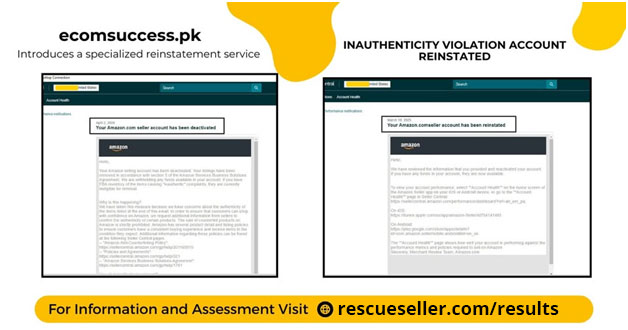
Case 01 Case file
Inauthenticity — authenticity complaints
The account was deactivated after customers complained that items were not genuine — the inauthenticity notice on the left. Amazon treats authenticity complaints as a supply-chain question: where did the stock come from, and can that be proven on paper.
The appeal answered that question with sourcing evidence behind a root-cause Plan of Action. The notice on the right confirms the outcome: the account was reinstated.
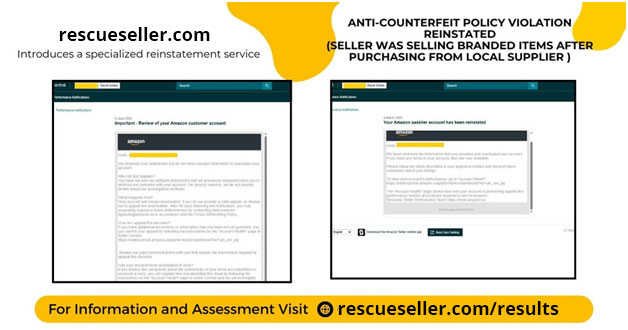
Case 02 Case file
Anti-counterfeit — branded stock from a local supplier
A common and dangerous pattern: genuine branded stock bought from a local supplier, flagged by Amazon as a counterfeit risk. Without a documented purchasing trail, Amazon assumes the worst.
The case was built on supplier invoices and supply-chain records that documented the stock end to end. The account was reinstated.
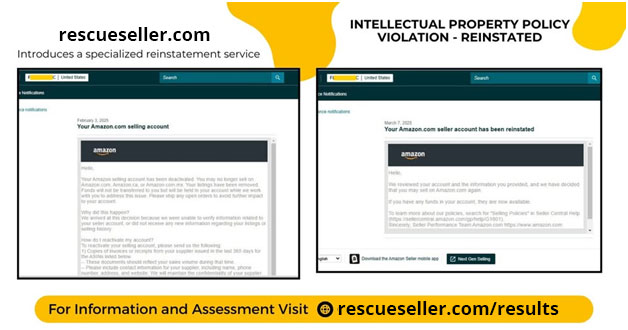
Case 03 Case file
Intellectual property — dated in Amazon’s own notices
This is the case file we show first, because Amazon dated it for us. The deactivation notice on the left is dated 7 February 2025; the reinstatement notice on the right is dated 7 March 2025.
Between those two dates sits the work: the complaint examined, the rights position documented, and an appeal that addressed the specific intellectual property claim rather than policy violations in general.
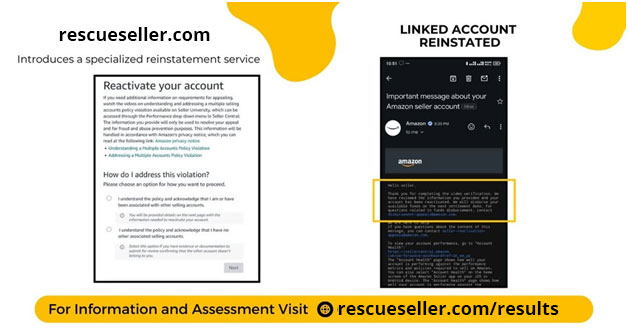
Case 04 Case file
Linked account — multiple accounts policy
The screen on the left is where linked-account cases begin: a “Reactivate your account” violation under Amazon’s multiple selling accounts policy. Amazon had connected this account to another, and the connection itself was the violation.
The appeal explained and documented the relationship between the accounts honestly. The message on the right is Amazon’s answer: the account was reinstated.
Case 05 Case file
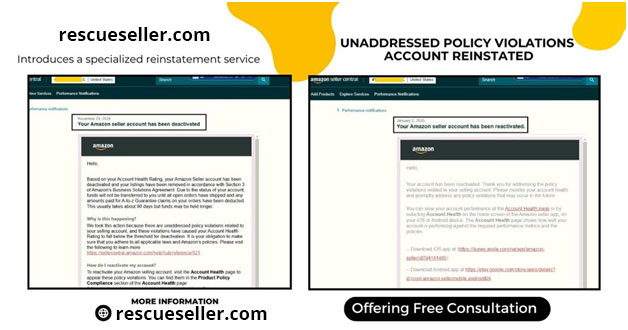
Section 3 — unaddressed policy violations
A Section 3 deactivation is the most serious notice Amazon sends. In this case the notice records that funds would be held and not transferred, because earlier policy violations had gone unaddressed until the account was closed.
The recovery worked through each open violation in turn, with a corrective record for every one. The notice on the right confirms the account was reactivated.
Case 06 Case file
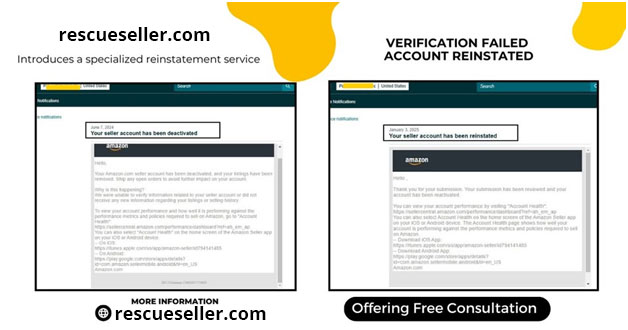
Verification failed — identity could not be verified
New accounts are often closed before they sell anything: Amazon could not verify the information behind the account, and deactivated it. The notice on the left is that deactivation.
These cases are usually document problems rather than conduct problems. The verification documents were corrected and resubmitted in the format Amazon requires, and the notice on the right confirms the seller account was reinstated.
Case 07 Case file
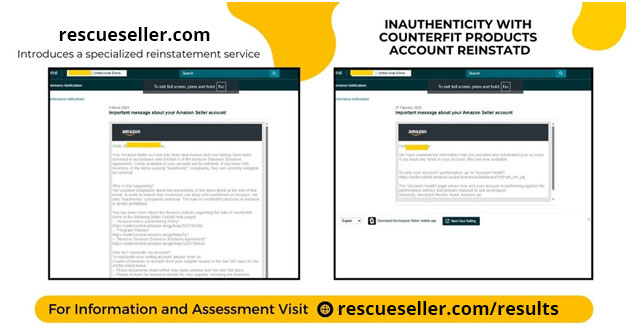
Inauthenticity — counterfeit products alleged
The practice’s case graphic for this file is headed “Inauthenticity with counterfeit products — account reinstated”. On the left is Amazon’s notice to the seller, headed “Important message about your Amazon Seller account”, setting out the inauthenticity concern.
On the right is the closing notice for the same account. As with every inauthenticity case, the appeal stood or fell on the supply chain: documents showing where the products came from, presented in the order Seller Performance reads them.
Case 08 Case file
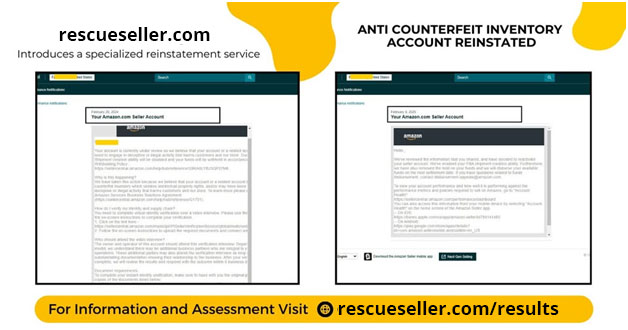
Anti-counterfeit — inventory flagged
Here the flagged problem was the inventory itself: stock Amazon’s systems treated as counterfeit, with the account notice on the left. Inventory cases are won on purchasing records — invoices that match the stock, from suppliers Amazon can verify.
The notice on the right states that Amazon reviewed the information provided and reinstated the account.
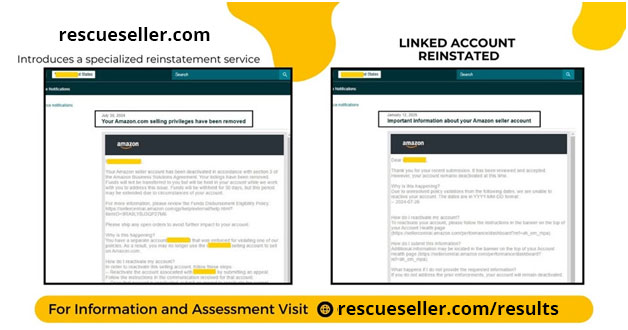
Case 09 Case file
Linked account — Section 3 deactivation
The notice on the left is a Section 3 deactivation: selling privileges removed and funds held, because Amazon linked this account to another account that had been enforced. The practice’s case graphic is headed “Linked Account Reinstated”.
Amazon’s reply on the right records that the submission was reviewed and accepted, and sets out the steps to reactivate the account. Linked-account cases turn on explaining the connection with documents, not denying it.
A note on proof: screenshots can be cropped to flatter anyone. What matters is the sequence — a deactivation notice, an appeal built on documents, and a reinstatement notice for the same account. That is the sequence we run on every case, and it is the sequence your free review starts.
Next Start a case
Your account could be the next file in this ledger.
Send the notice. We will tell you where you stand, what it will take, and what it costs — in that order.
Your documents are used only to prepare your appeal.